
Low Sperm Concentration: Causes and How It Is Evaluated
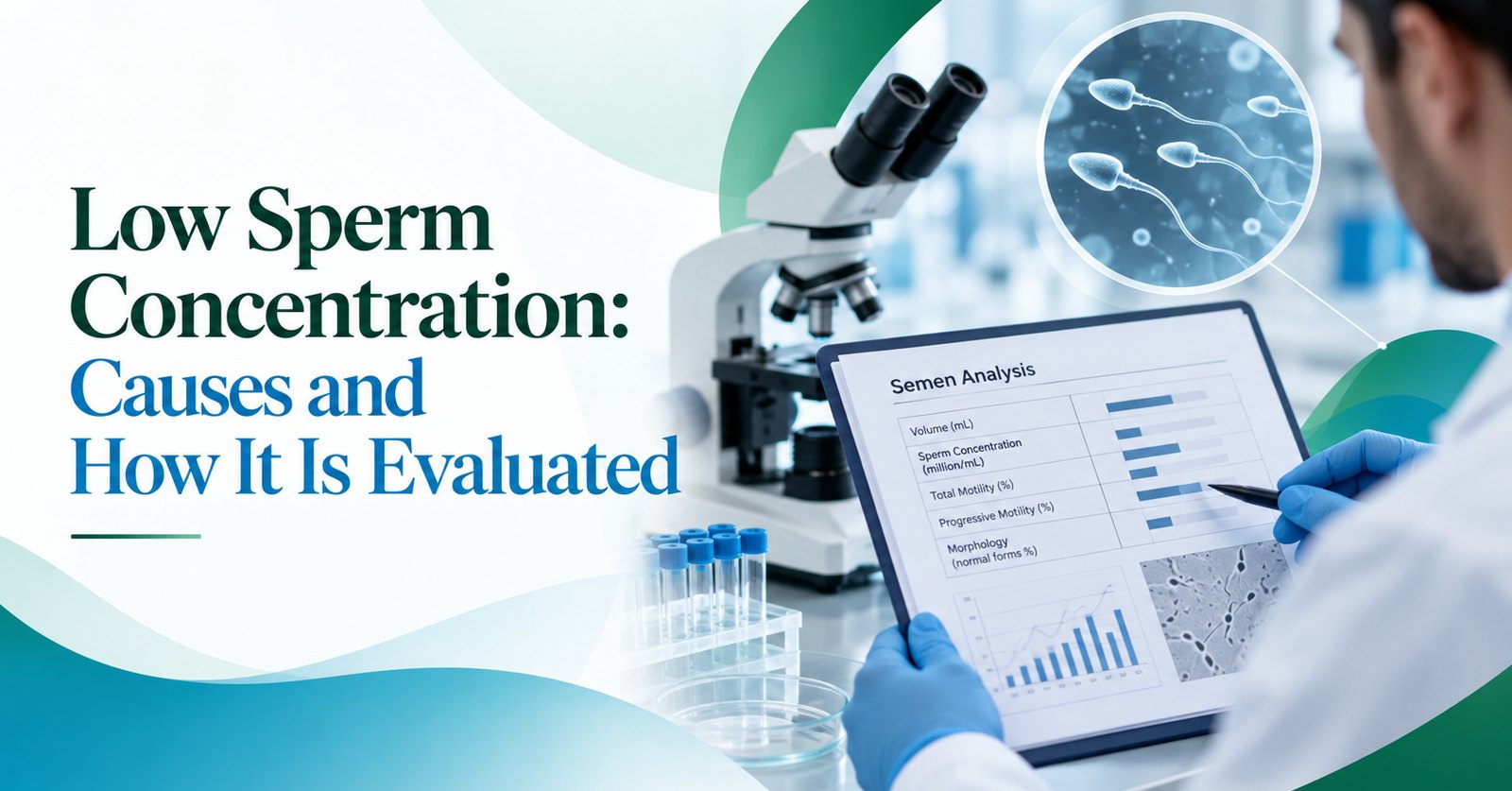
A semen analysis report comes back with one figure circled, or flagged in red, or simply sitting below a number in brackets. Concentration. Low.
What follows is usually an hour of searching, a growing sense that something has been settled, and no clear idea of what happens next. In fact, almost nothing has been settled. A single low concentration is the beginning of an investigation, not the end of one.
Here is what the figure measures, what can cause it to read low, and what a proper evaluation looks like.
What sperm concentration measures
Concentration is the number of sperm in each millilitre of semen. It is one of four things a standard semen analysis reports, alongside volume, motility and morphology.
It is a density measurement, not a total. That sounds like a technicality and it is not, as the third section explains.
The clinical term for a concentration below the reference limit is oligozoospermia. Where it is markedly below, the word severe is added, and where no sperm are found at all the term is azoospermia, which is a different situation requiring a different investigation.
What counts as a low sperm concentration?
Laboratories work to reference limits published by the World Health Organization, and the figure for concentration sits at roughly 16 million sperm per millilitre.
A reference limit is not a pass mark. It is the lower boundary of a range found in men who achieved a pregnancy within a year.
That distinction is worth sitting with. Being below the limit does not place you in a category of men who cannot conceive. It places you below a statistical boundary drawn from a fertile population and men below that boundary conceive, while men comfortably above it sometimes do not.
It also means the number on your report is only meaningful against the limits your laboratory uses, in the units it uses. Reports from different laboratories are not always directly comparable.
Concentration is not the same as total sperm count
This is the most common misreading of a semen analysis, and it causes a great deal of unnecessary worry.
Concentration is sperm per millilitre. Total count is concentration multiplied by the volume of the sample. A man with a large volume and a modest concentration can have a perfectly ordinary total count, and a man with a small volume and a decent concentration can have a low one.
Both figures appear on the report, and the total count is often the more useful of the two. If only the concentration was mentioned to you, look for the total before drawing any conclusion from it.
Why one low result is not a diagnosis
Semen quality varies considerably in the same man from one month to the next. Illness, sleep, stress, heat, alcohol and the abstinence interval all move the numbers, sometimes substantially.
A single result is a snapshot of one particular day. It is genuinely common for a repeat sample, taken a week or two later, to look quite different and standard practice is to repeat before drawing any conclusion.
There is a timing point underneath this that explains a great deal. Sperm takes around three months to develop from first cell to finished product, so a result reflects the preceding three months rather than the preceding week. A fever two months ago may be showing up now. And any change made today will not appear in a result for about a quarter of a year, which is why retesting at four weeks tells you very little.
What causes a low sperm concentration
The causes fall into a few groups, and the point of an evaluation is to work out which applies.
Varicocele. Enlarged veins in the scrotum, which raise the local temperature. One of the commoner findings, and one of the few that is directly correctable though not every varicocele needs treating.
Hormonal. The signalling that drives sperm production can be disrupted at several points. Raised FSH generally points towards the testes themselves; low FSH and LH point towards the pituitary. Raised prolactin and thyroid disorders can also be involved. A hormone panel usually forms part of the assessment, and low testosterone is one of the findings it can turn up.
Medication and supplements. Testosterone supplements and anabolic steroids are the big ones, and they are frequently not mentioned because people do not think of them as medication. Both suppress the body’s own sperm production, sometimes severely. Several other drugs affect production too. Nothing should be stopped without advice, but everything should be disclosed.
Infection and inflammation. Past infection of the testis or epididymis can leave a lasting effect on production, and mumps after puberty is a specific example worth mentioning if it applies.
Previous surgery or injury. An undescended testis treated in childhood, a torsion, a hernia repair, or trauma can all be relevant, sometimes decades later.
Heat and lifestyle. Sustained heat from saunas or prolonged hot baths, smoking, heavy alcohol use and raised body weight all affect production. These matter, though they are rarely the whole explanation on their own.
Genetic. A smaller group, and more likely where the concentration is very low. Covered in section seven.
No cause found. A substantial proportion of cases are idiopathic, meaning a thorough evaluation finds no identifiable reason. That is an unsatisfying answer and an honest one, and it does not mean nothing can be done.
How low sperm concentration is evaluated
A proper assessment has a shape to it, and it begins with confirming the finding rather than acting on it.
The first step is a repeat semen analysis, usually at least a week or two later, with a similar abstinence interval so the two can be compared. If the second sample is normal, the picture changes entirely.
Alongside that, a history and a physical examination. The history covers childhood problems, infections, surgery, medication, occupational heat exposure and lifestyle. The examination assesses testicular size and consistency, checks for a varicocele, and confirms the vas deferens is present on both sides, a finding that occasionally explains a great deal on its own.
Blood tests follow, typically FSH, LH, testosterone and prolactin. The pattern across those four points towards where the problem sits, which is more useful than any one of them alone.
A scrotal ultrasound is often added, particularly where the examination raises a question.
Where the standard parameters do not explain the picture, or where there is unexplained infertility or recurrent miscarriage, further testing of sperm function looks at things a routine analysis does not the integrity of the DNA inside the sperm, and whether they are capable of fusing with an egg.
When genetic testing is considered
Where the concentration is very low rather than mildly reduced, genetic testing becomes relevant. Two investigations are usual: a karyotype, which looks at the chromosomes overall, and testing for small deletions on the Y chromosome.
These are worth doing for two reasons. They sometimes explain a picture that otherwise has no explanation, and where assisted conception is being considered they carry implications that are better understood beforehand than afterwards.
Not everyone with a low concentration needs them. The threshold is a clinical judgement based on how low the figure is and what else the assessment has found.
What a low concentration means for conceiving
It means conception is likely to take longer on average. It does not mean it will not happen.
The relationship between concentration and the chance of conceiving is a gradient rather than a cliff. There is no figure below which pregnancy stops being possible and above which it is assured, which is why reading a single number as a verdict is both common and wrong.
Where assistance is needed, the concentration partly determines which route makes sense. A modest reduction may still allow intrauterine insemination. A more significant one usually points towards IVF with ICSI, where a single sperm is injected directly into each egg.
And where a correctable cause is found, addressing it sometimes improves the figure though any change takes about three months to appear, for the reason given earlier. What is realistic depends entirely on what the evaluation turns up, which is the argument for having one rather than guessing. A broader assessment of male infertility looks at the whole picture rather than at one number.
Frequently asked questions
What is a normal sperm concentration?
Laboratories work to a reference limit of roughly 16 million sperm per millilitre. That is a lower boundary drawn from men who conceived within a year, not a pass mark, and being below it does not place you in a category of men who cannot conceive.
What is the difference between sperm concentration and total sperm count?
Concentration is sperm per millilitre. Total count is concentration multiplied by the volume of the sample. A low concentration with a large volume can still give a normal total count, which is why both figures should be read together.
Can you conceive naturally with a low sperm count?
Yes. The relationship between concentration and conception is a gradient rather than a threshold. A lower figure generally means it takes longer on average, not that it cannot happen.
What is the most common cause of a low sperm count?
Varicocele is among the commoner identifiable findings, and hormonal causes, past infection and medication account for a further share. A substantial proportion of cases are idiopathic, meaning no cause is found despite a thorough evaluation.
How long does it take for sperm count to change?
Around three months. Sperms take roughly that long to develop, so any change in a treated infection, a stopped medication, a lifestyle change takes about a quarter of a year to appear as a result. This is why retesting after four weeks is not informative.
Does a low sperm count mean I need IVF?
Not necessarily. A modest reduction may still allow intrauterine insemination or natural conception. The route depends on the figure, on what the evaluation finds, and on the female assessment alongside it.
Should the test be repeated?
Yes. Semen quality varies considerably month to month in the same man, so a single result is a snapshot. Standard practice is to repeat before drawing a conclusion, with a similar abstinence interval so the two can be compared.
Conclusion
A low concentration on one report is a reason to look further, not a conclusion. It should be repeated, read alongside the total count rather than on its own, and followed by an examination and a hormone panel before anybody decides what it means.
A good proportion of the causes are identifiable, some are correctable, and the figure itself is a gradient rather than a threshold. What it does change is the value of finding out why.
Book a confidential consultation at Ankur
This article is for general information and is not a substitute for individual medical advice. Reference limits and units vary between laboratories; results should be interpreted by a clinician who knows your history.