
PCOS and Fertility: How Polycystic Ovary Syndrome Affects Conception
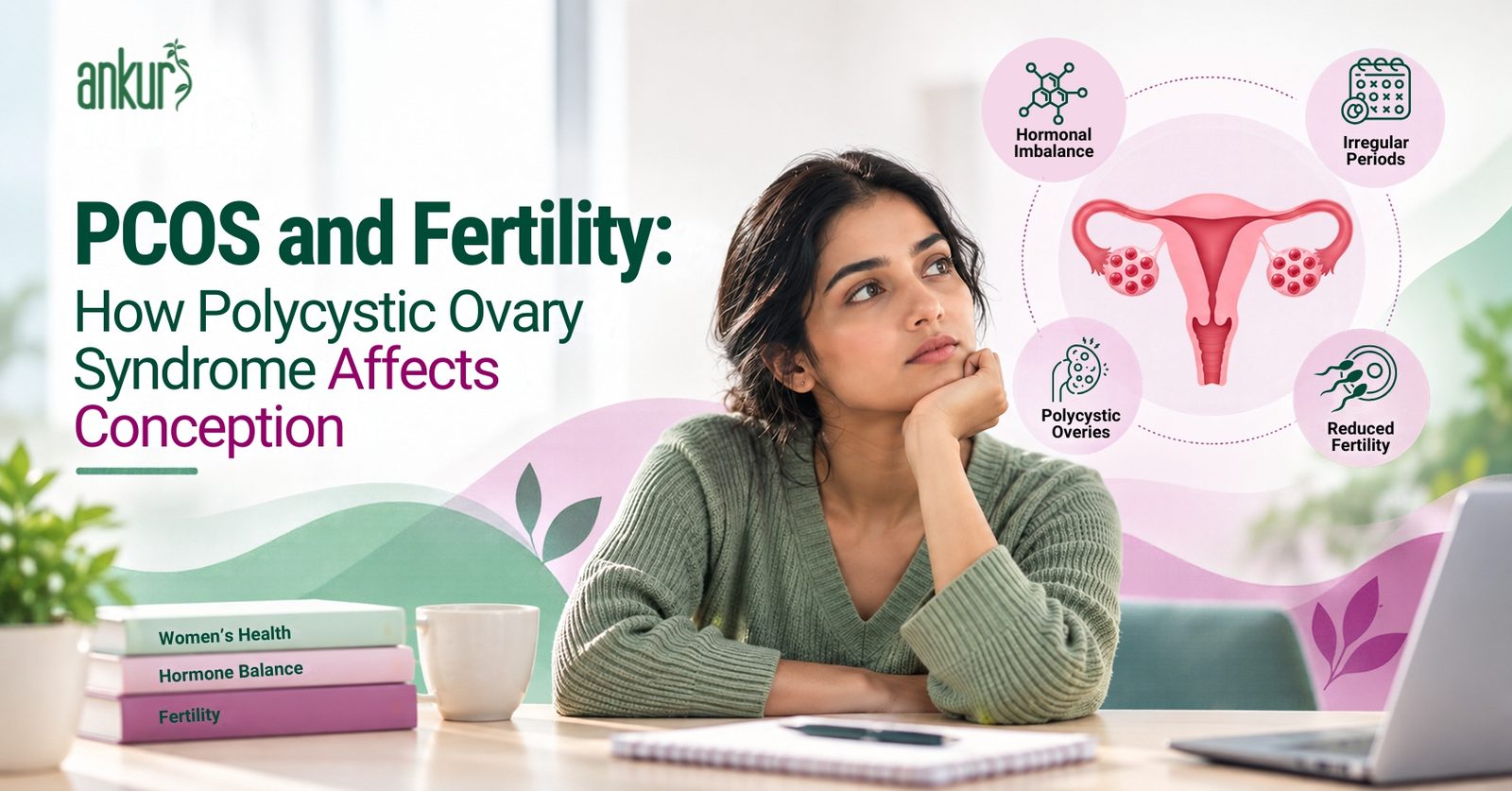
Most women hear about PCOS twice. The first time is when someone mentions irregular periods and orders a scan. The second is years later, when conceiving is taking longer than expected and the diagnosis comes back into the room carrying a great deal more weight than it did before.
In between, very little gets explained. The name suggests cysts, which is misleading. The internet suggests infertility, which is worse than misleading. And the actual mechanism of what PCOS does to ovulation, and why that matters for conception rarely gets a clear explanation at all.
Here is that explanation.
What PCOS actually is
Polycystic ovary syndrome is a hormonal condition, not a disease of the ovaries. The name is a historical accident and it misleads almost everybody who hears it.
The "cysts" are not cysts. They are ordinary follicles the small fluid-filled sacs every ovary contains, each holding an immature egg. In PCOS a larger number than usual begins to develop but none progresses to the point of releasing an egg. They stall partway and accumulate, which is what gives the ovary its characteristic appearance on an ultrasound. Nothing is growing that should not be there.
What sits underneath is a disturbance in the hormonal signalling that normally drives one follicle to maturity each month. Raised androgen levels are part of it. So, often, is insulin resistance which is why PCOS is as much a metabolic condition as a reproductive one, and why it has effects well beyond fertility.
PCOS is common. Estimates vary with the criteria used, but it affects a substantial minority of women of reproductive age, and many do not know they have it.
How PCOS affects ovulation
In a typical cycle, hormonal signals select one follicle, mature it over about two weeks, and trigger its release. That released egg is the only one available to be fertilised that month.
In PCOS, that selection process does not complete reliably. Several follicles begin, none is clearly chosen, and the trigger to release does not arrive. The result is ovulation that happens irregularly, unpredictably, or in some months not at all.
This is why cycles become long or erratic. A woman with PCOS may go several months between periods, or have periods that arrive without ovulation having occurred at all, which is not the same thing, and matters when you are trying to conceive.
It also explains why ovulation tracking is harder with PCOS. Predicting a release that may not happen is difficult, and some home ovulation tests read falsely positive in PCOS because of the underlying hormone levels.
The barrier in PCOS is usually ovulation, not the egg itself. Egg quality is generally not the problem.
Does PCOS mean you cannot get pregnant?
No. And the gap between what PCOS actually means and what people assume it means causes a great deal of avoidable distress.
PCOS is one of the commoner reasons conception takes longer. It is not a diagnosis of infertility. Many women with PCOS conceive without any assistance, sometimes without ever knowing they had it. Others conceive after the ovulation problem has been identified and addressed.
The distinction worth holding on to is that PCOS affects how regularly the opportunity arises, rather than whether it can arise at all. A cycle in which ovulation happens is, in most respects, an ordinary cycle.
It is also worth saying that "I have PCOS" covers a wide range. Some women ovulate most months and have mildly irregular cycles. Others ovulate rarely. The implications for conception are quite different, and a general statement about PCOS tells you very little about your own situation.
How PCOS is diagnosed
There is no single test. Diagnosis rests on a combination of findings, with other causes excluded first — thyroid disorders and raised prolactin can produce similar cycle disturbance and need ruling out.
Three features are assessed. Whether ovulation is irregular or absent, usually established from cycle history and supported by blood tests. Whether there are signs of raised androgens, either clinically or on blood testing. And the appearance of the ovaries on ultrasound.
Two of the three are generally required. This is why one ultrasound on its own does not make the diagnosis, and why polycystic-appearing ovaries seen incidentally on a scan do not necessarily mean PCOS.
Where conception is the concern, the assessment usually goes further ovarian reserve, thyroid function, prolactin, an assessment of the uterine cavity and tubes. A full fertility assessment looks at the whole picture rather than at PCOS in isolation, because PCOS and another factor can perfectly well coexist.
The symptoms that matter for fertility
PCOS produces a long list of possible symptoms, and most articles simply reproduce it. For conception specifically, a smaller number carry weight.
Irregular or absent periods. The most directly relevant. Cycles consistently longer than about 35 days, or fewer than eight or nine periods a year, suggest ovulation is not happening reliably.
Signs of raised androgens. Acne that persists past adolescence, unusual hair growth on the face or body, or thinning scalp hair. These reflect the hormonal picture underneath.
Weight changes and difficulty losing weight. Related to the insulin resistance that often accompanies PCOS. Not universal PCOS occurs in women of every body size, and lean PCOS is frequently missed for exactly that reason.
Darkened skin patches. At the neck, armpits or groin. A visible marker of insulin resistance and worth mentioning at a consultation.
Symptoms that get a great deal of attention but say little about fertility include mood changes, fatigue and sleep disturbance. They are real and worth addressing. They are not what determines whether you conceive.
What helps, roughly in order
Management is stepwise, and the first steps are not dramatic. What follows describes the shape of fertility care for PCOS rather than a protocol; the specifics depend on the assessment.
Where weight is raised, a modest reduction often improves how regularly ovulation happens and the amount required is usually smaller than people expect. This does not apply universally, and it is not a useful instruction for a woman who is already lean.
Addressing insulin resistance, where it is present, is often part of the approach, because the metabolic and reproductive sides of PCOS are connected rather than separate.
Where ovulation is not happening and the cycle history confirms it, there are established medical approaches to inducing it, used under monitoring. Which is appropriate, and whether it is appropriate at all, depends on the individual assessment. This is a conversation with a clinician rather than something to plan from an article.
What is worth knowing is the shape of it: assessment first, then the simplest intervention that addresses what the assessment found, with more involved approaches considered only if those do not work. A move straight to IVF on the basis of a PCOS diagnosis alone would be unusual.
Where IVF and ICSI fit in
IVF is not the first answer to PCOS, and a clinic proposing it as one should be asked why.
It becomes relevant in specific circumstances: where ovulation induction has been tried without success, where the tubes are blocked or damaged, where there is a significant male factor alongside, or where age makes waiting the greater risk. In other words, IVF addresses PCOS-related infertility when something other than ovulation timing is also in play.
One practical point. Women with PCOS often respond strongly to ovarian stimulation more follicles develop than in a typical cycle. That can be an advantage in terms of eggs retrieved, but it also raises the risk of over-response, which is why protocols are usually adjusted and monitoring is closer. A clinic that treats a PCOS cycle identically to any other is not paying attention.
The male side still needs checking
This gets skipped constantly, and it is worth resisting.
When a woman has a clear diagnosis, it becomes the assumed explanation and the investigation stops there. But male factors are involved in roughly half of couples who have difficulty conceiving, and a PCOS diagnosis does nothing to exclude one. The two coexist as often as chance would suggest.
A semen analysis is quick, inexpensive and far less invasive than anything on the female side. It should be done early rather than after several cycles of treatment aimed at one partner have not worked. Where the basic parameters are normal but conception still is not happening, further assessment of sperm function is sometimes what changes the picture.
A diagnosis in one partner is not a reason to stop investigating the other.
PCOS after you conceive
PCOS does not disappear with a positive test, and it carries some implications for pregnancy itself.
There is a somewhat raised likelihood of certain complications, gestational diabetes and blood pressure changes among them which is why pregnancies in women with PCOS are usually monitored a little more closely than average. That is a precaution rather than a warning. Most proceed entirely normally.
It is worth mentioning the diagnosis at the first antenatal appointment even if nobody asks, so the monitoring is planned rather than reactive.
Frequently asked questions
Can you get pregnant with PCOS?
Yes. PCOS affects how regular ovulation happens rather than preventing it outright, and many women with PCOS conceive without assistance. Where ovulation is irregular or absent, it can often be addressed.
How does PCOS affect ovulation?
Hormonal changes in PCOS can stop follicles maturing and releasing an egg, so ovulation becomes irregular or stops altogether. This is why periods are often infrequent or unpredictable.
How is PCOS diagnosed?
Diagnosis is based on a combination of irregular or absent ovulation, signs of raised androgens on examination or blood tests, and the appearance of the ovaries on ultrasound. Two of the three are generally required, with other causes excluded.
Does PCOS mean you are infertile?
No. PCOS is a common cause of difficulty conceiving, not a diagnosis of infertility. It affects the regularity of ovulation, and that is often something that can be assessed and managed.
Does losing weight help with PCOS and fertility?
Where weight is raised, a modest reduction can improve how regularly ovulation happens. It is not the whole answer and it does not apply to everyone, since PCOS also occurs in women of normal weight.
Do you need IVF if you have PCOS?
Not usually as a first step. Assessment normally begins with whether ovulation is happening and why not, and IVF is considered where simpler approaches have not worked or where other factors are also present.
Can PCOS be cured?
PCOS is a long-term condition rather than one that resolves, but its effects on ovulation, cycles and metabolic health can be managed. The aim is management rather than cure.
Does PCOS affect pregnancy once you conceive?
It can raise the likelihood of certain complications, which is why pregnancies in women with PCOS are usually monitored a little more closely. Most proceed normally.
The short version
PCOS is a hormonal condition that disrupts ovulation. The cysts are not cysts, the eggs are generally fine, and the difficulty is that the opportunity to conceive arises less predictably rather than not at all.
Diagnosis needs more than one scan. Management is stepwise and starts with the simplest thing that fits what the assessment found. IVF is a later option, not a first answer.
And whatever the diagnosis says about one partner, the other still needs checking.
Conclusion
A PCOS diagnosis changes the timeline, not the outcome. It affects how predictably the opportunity to conceive arises, rather than whether it can arise at all and that distinction is the one most worth holding on to after a scan report lands.
What it does mean is that guessing becomes unreliable. Tracking apps and home ovulation tests are less useful in PCOS than elsewhere, which is why knowing whether ovulation is actually happening, and why not, is the first useful step rather than a formality.
And a diagnosis in one partner is not a reason to stop investigating the other.
Book a confidential consultation at Ankur
This article is for general information and is not a substitute for individual medical advice. PCOS presents differently in different women, and management should follow assessment by a clinician who knows your history.